
I did a lot of my growing up in a rural farming town in southern Illinois. My grandfather and my uncle were both farmers, and so were a bunch of my friends and their families. I loved the radio show A Prairie Home Companion because it always felt like it could’ve been talking about my hometown. Much like Lake Wobegon, actual farming towns of the rural Midwest really are filled with a wonderful cast of characters spouting folksy sorts of wisdom. I hadn’t fully appreciated how true this was until I mentioned in passing to my wife one day, “Welp, you can see the backs of the leaves on the trees. Gonna rain.” She looked at me like I must be having a stroke or something. When I asked if she’d ever heard that, she assured me that no one had ever heard that and that I must be trying to get her to believe something outrageous for my own amusement. (In fairness, I do that quite often, though after many years I can’t get much by her.)
I told her no, I wasn’t messing with her, this truly was something I learned from my grandfather. And, in my experience, it was a pretty decent indicator of rain coming. Not perfect, but surprisingly good given that all you need is your eyes, some trees, and some of that folksy wisdom. If you could see the backs of the leaves *and* you felt that hard-to-describe hint of chilly in the middle of the breeze (that’s the best way I’ve found to try to talk about the sensation), rain was very likely. I still go by this, and I don’t very often get wet while walking the dog or cancel outdoor plans that could’ve been kept.
What I’m getting at is that sometimes those feel-it-in-your-bones kinds of things can be worth paying attention to and thinking about. More and more, I have a feeling in my bones that the biomedical research workforce is in trouble. I can’t shake the feeling, so I want to try to understand it.
“It’s 100% If It’s You”
In keeping with the folksy aphorisms, I’m reminded of what an oncology surgeon used to teach his learners when I was a medical student. He would ask what the likelihood was that someone would develop a particular kind of cancer in their lifetime, and once the group got to the correct answer from epidemiology, he’d say in his gentlemanly Southern drawl, “Remember though, it’s 100% if it’s you.” So, I want to talk about my own personal experience with the biomedical research workforce over the last 18 months, and why it has me so worried.
I was talking with a friend the other day about our shared struggles with finding a job in the current job market for biomedical research. When I say biomedical research, I’m talking in a very broad sense – academic research, pharma, biotech, policy, nonprofits, global health, science communications, all of that. Talking about it prompted me to reflect on what my own job search experiences have been. I know it has felt truly awful, but looking at it retrospectively provided a view I didn’t expect.
This part is hard to write because I don’t want to sound boastful or anything like that. But, it’s important to know some facts about me to understand the rest. So, some of the facts relevant to my job search are as follows: I have an MD degree and a PhD in Pharmacology, both from Vanderbilt University. I graduated as the Founder’s Medalist for the School of Medicine – that is, the top of my class – at Vanderbilt in 2006. I am board certified in internal medicine, pulmonary medicine, and critical care medicine and have an active license to practice. I have 91 published papers (and several more in the works, hoping to break 100 soon). I have discovered molecules and seen them go all the way to inclusion as endpoints in clinical trials. I have held positions as a faculty member at Vanderbilt University, as a Medical Officer at the National Heart, Lung and Blood Institute, and as the Chief Medical Officer and part of the leadership team at the National Center for Advancing Translational Sciences.
And yet, from April 2025 to July 2026 (that’s when I’m writing this) in the United States, I applied and failed at 6 big pharma companies, 3 mid-size pharma companies, 5 nonprofits, 1 biotech, 1 data company, 1 university, and 1 state health department. That’s 18 shots and 18 misses, not counting a couple of things that didn’t work out for reasons that I can’t or won’t go into here. The applications were of a wide variety of types, from cold responses to postings all the way to “we’re trying to create a position with you in mind” led by people who are friends as well as colleagues. Some were part-time, some short term, some long term. Some would’ve been a stretch for my existing skills, others were (I thought) right over home plate.
This kind of retrospective summary gave me a whole new perspective on my own job search. This was way beyond humbling, and I blew past humbled months ago. I’ve been far enough into Self-Doubtville for long enough that I’ve built a little cottage and have had my mail forwarded there. No, this retrospective look was more than that. It was scary, and my immediate response was to try to figure out what’s wrong with me.
· Is it because I’m a former Federal employee and published a very honest resignation letter? That may/probably does contribute sometimes, but *tons* of other scientists are having this exact same experience. I’ve recently spoken with several close friends who are scientists, and they’ve all said that they’ve had superstars from their labs who have had to look for jobs for years and have had to take insufficient part-time work just to try to keep the bills paid.
· Is it because I’m looking too close to where I live? Again, not really, as I live in a target-rich environment, I started casting a wider geographic net, and friends across the country are having the same experiences.
· Is it because I don’t have the right kind of resume or CV for the positions I’m seeking? There’s definitely been some learning, but for a good while I’ve had a resume and CV for every conceivable kind of job opening. I’ve adjusted length, format, ability to interface with the abomination that is the Workday AI tool (how’s Mobley v. Workday, Inc. going, anyway?), all of the parameters, and it hasn’t changed the experience or the outcome.
· Speaking of Mobley v. Workday, Inc., am I too young or too old? In a word, no. I’ll be 50 in a year. And in my extensive network, I cannot identify any particular age group that is obviously doing better or worse with job search.
I want to believe that it’s something about me specifically, because that would mean that overall we’re going to be okay. But everything I can find suggests that it’s not just me. That’s very worrisome indeed.
An Also-Ran?
According to an analysis done by BioSpace and published in early 2026, U.S. biopharma alone lost 43,000 jobs in 2025. This was attributed to lack of capital, big downsizing at some of the largest pharma companies, and some region-specific losses. The article has a lot of jargony sort of business-speak in it, but the bottom line is that 43,000 jobs vanished from the biopharma sector. Add to that 43,000 the 17,000+ people lost from the Department of Health and Human Services in 2025, the roughly 10,000 jobs lost at U.S. universities (many related to reductions in funding for research) in 2025, and a reduction in admissions to U.S. doctoral programs in 2025, it was a pretty grim year for the U.S. biomedical workforce. I’m not an economist or anything like that, but I can’t really say that I’ve seen a ton of data suggesting that the situation has dramatically improved in 2026 so far.
For a good while now, the United States has led the world in biomedical research and innovation. That’s not an accident, and there are multiple components that contribute to that status. The U.S. has invested heavily in publicly funded biomedical research, and that investment has served as the bedrock upon which the biomedical innovation enterprise rests. Careful attention and significant resources have gone to ensuring that medical products are what they say they are and do what they say they do, safely. It’s so fundamental that we don’t even think about whether the medicine we’re about to take is actually what it’s supposed to be or whether we can believe that it’ll do what we think it’s going to do. For the research that lets us have that kind of trust, there are also robust mechanisms to ensure that when we give of ourselves by being participants in research, our well-being is protected and our personhood respected. And we have invested in training future generations of researchers, clinicians, policy experts, bioethicists, drug development experts, and all of the other kinds of professionals needed to keep the biomedical enterprise going and growing. We’ve been so good at it that the rest of the world has sent their best and brightest here to learn how it’s done.
I worry very much that the lack of jobs in the biomedical research enterprise, even for people with pretty legit qualifications, is an ominous sign of what may be happening. I worry that we’re seeing the backs of the leaves, feeling the breeze get chilly fast, and seeing the sky turn that shade of weird green that means a big, bad storm is coming. One that’ll level your barns and kill your livestock.
There’s a lot of discussion right now about maintaining American competitiveness in the global biomedical sector. How can that happen if there are no jobs in that sector here? There are big ideas and big plans about how to continue to lead. How do those happen if there’s no workforce to carry them out? There seems to be interest in shifting investment of public support for biomedical innovation from universities to the private sector. How does that help if there aren’t jobs there now *and* if funds are being diverted away from the places where we train the next generations of the biomedical workforce?
For the first time this past week, I heard someone outside the U.S. say something I myself have worried a lot about and that I have said almost word for word: “The U.S. could conceivably become an also-ran.” If you’re unfamiliar with the term (I’ve learned that it’s not as commonly used as I thought), an also-ran is someone who isn’t a top finisher in a race but rather finishes with the rest of the pack – in other words, not a winner, just someone who also ran. The U.S.’s position of global leadership in biomedical innovation did not happen by accident, nor did it happen by fiat or proclamation or executive order. It happened by careful attention to and support of all of the different pillars – a brilliant workforce, discoveries that change paradigms, thoughtful development of diagnostics and treatments, careful and ethical testing of those products, regulation that protects both safety and innovation to allow the private sector to thrive in the presence of public trust, and others. These are the very pillars that are threatened right now in the U.S., though it should be noted that they’re not nearly as threatened elsewhere in the world.
I see the backs of the leaves, but I don’t believe it’s inevitable that we lose the farm to the coming storm. It’s still possible for us to get back on track. I think it starts with protecting the workforce, so that whatever else we might want to do, we have the best and brightest available and ready to do it. That’s our umbrella. Then we can have truly informed discussions about the other pillars. Conversely, without a robust biomedical workforce, there will be no experts to create and deploy the plans that’ll keep us where we want to be. Without an umbrella, we’re going to get soaked.
**************************************
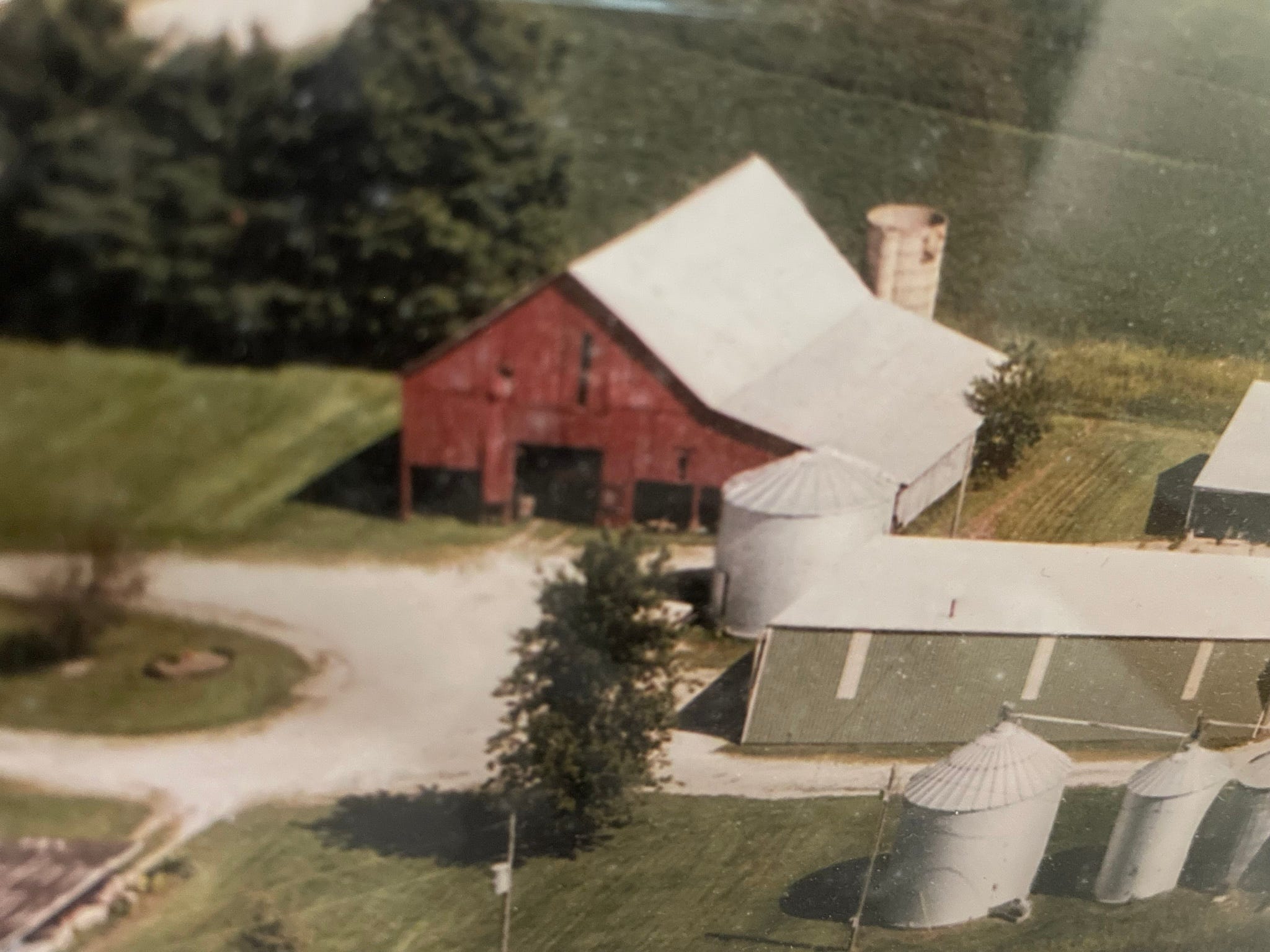
This was the barn on my family farm when I was a kid. This was where I learned to look at the backs of the leaves on the trees.
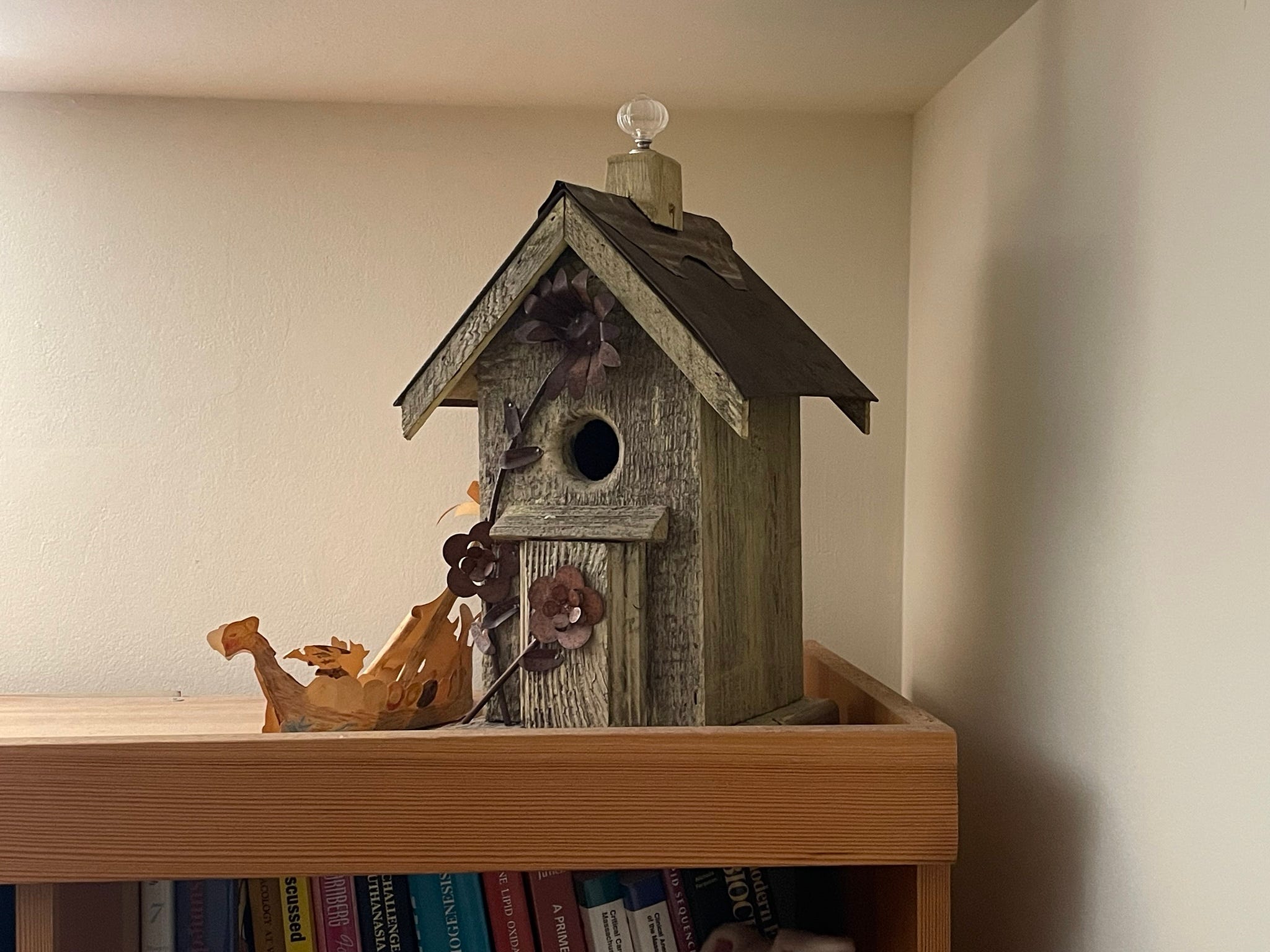
This birdhouse is made from the wood and metal that used to be that barn. The barn was destroyed by a tornado.